
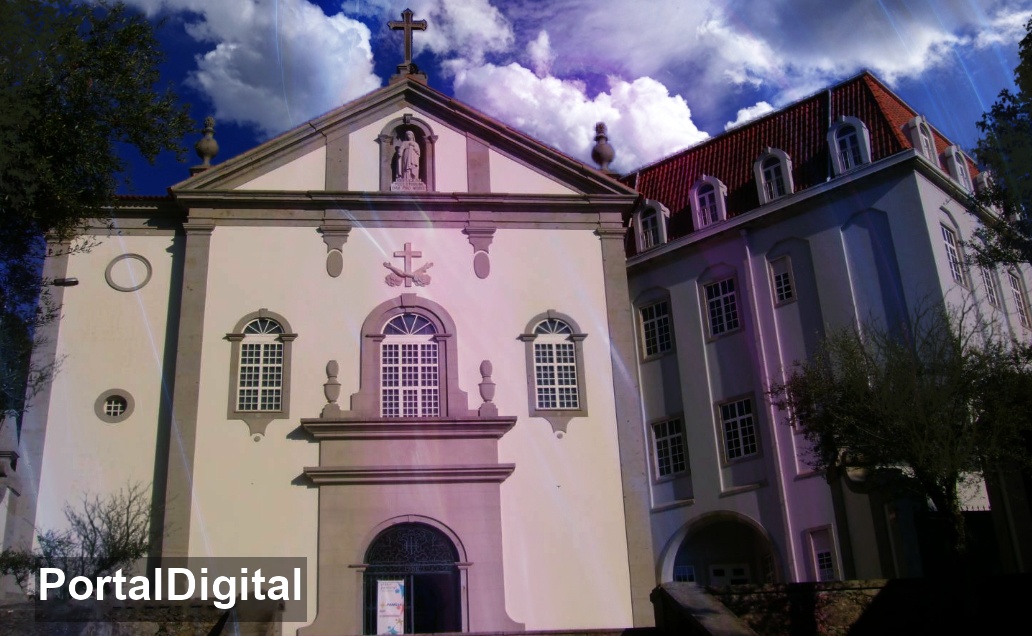
Rua do Areal de Cima, in Braga
The Church of Montariol is a church belonging to the Montariol Seminary in Braga, located on Rua do Areal de Cima, city of Braga, northern Portugal.
The church is built on Monte Calvelo and is one of the city's viewpoints.
The church is built on Monte Calvelo and is one of the city's viewpoints.
History
The hill that is now known as Montariol, in the city of Braga, was first known as Monte Calvelo.
The toponym of Montariol, according to Jerónimo Contador de Argote, an 18th century historian, derives from hill and sand, an etym also present in the name of the neighboring place Areal.
In the second half of the 13th century, D. Martinho Geraldes (1256-1271), who also exercised jurisdiction over Braga, established the Morgado of Montariol.
In 1562, the farm located on the hill of Montariol was purchased by the Society of Jesus, and a country house was built for the staff of its Colégio de S. Paulo de Braga, which had been granted to them two years earlier by Archbishop D. Frei Bartolomeu dos Mártires.
The first superior was Blessed Inácio de Azevedo, martyr at the hands of the French Calvinists in 1570 in the Canary Sea, when he was heading to the missions in Brazil.
From the Jesuit period we also have the stone gate at the bottom of the staircase, dated 1698 and surmounted by the coat of arms of the Society of Jesus (JHS).
Part of the wall that goes up to the printing house probably still dates back to that time, with some trees coming from Japan, such as Japanese trees and camellias.
In 1562, the property was purchased by the Jesuits to build their House of Formation. After their expulsion, it was sold to the father of the Viscount of Montariol, who passed it on to his son, the Viscount of Negrelos, remaining in possession until 1890.
In 1890 it was purchased at public auction by the Franciscans, who established a college and a seminary there and renovated the church and other facilities, and the person responsible for the works was master Guilherme Pereira, father of Domingos Pereira.
Restoration works began on May 5, 1891, and on September 27 of the same year the church was blessed by Archbishop D. António José de Freitas Honorato.
The Franciscan Congregation remained in Montariol until 1911, and then came into the possession of the State and installed a Cavalry Regiment there.
The expulsion of the Jesuits, decreed by the Marquis of Pombal in 1759, interrupted two centuries of presence of the disciples of Saint Ignatius.
In 1940, through a Concordat between the Holy See and the Portuguese State, the group was returned to the Church again, and the Franciscan Order was installed there in its Convent.
The austere facade bears the coat of arms of the Order of Saint Francis, and a niche with an image of Our Lady, invoking the Refuge of Sinners.
Its interior has several altars decorated with carved carvings, in a late Neoclassical style.
The church was remodeled, opening on December 21, 2003, where new windows were placed and the building was painted white.
At Christmas time, the Montariol Church houses the oldest nativity scene in the city of Braga, which attracts many visitors and tourists to this place.
Its assembly, as well as the conservation of the collection, has been entrusted since 1993 to the Corpo Nacional de Escutas or Portuguese Catholic Scouting.
The toponym of Montariol, according to Jerónimo Contador de Argote, an 18th century historian, derives from hill and sand, an etym also present in the name of the neighboring place Areal.
In the second half of the 13th century, D. Martinho Geraldes (1256-1271), who also exercised jurisdiction over Braga, established the Morgado of Montariol.
In 1562, the farm located on the hill of Montariol was purchased by the Society of Jesus, and a country house was built for the staff of its Colégio de S. Paulo de Braga, which had been granted to them two years earlier by Archbishop D. Frei Bartolomeu dos Mártires.
The first superior was Blessed Inácio de Azevedo, martyr at the hands of the French Calvinists in 1570 in the Canary Sea, when he was heading to the missions in Brazil.
From the Jesuit period we also have the stone gate at the bottom of the staircase, dated 1698 and surmounted by the coat of arms of the Society of Jesus (JHS).
Part of the wall that goes up to the printing house probably still dates back to that time, with some trees coming from Japan, such as Japanese trees and camellias.
In 1562, the property was purchased by the Jesuits to build their House of Formation. After their expulsion, it was sold to the father of the Viscount of Montariol, who passed it on to his son, the Viscount of Negrelos, remaining in possession until 1890.
In 1890 it was purchased at public auction by the Franciscans, who established a college and a seminary there and renovated the church and other facilities, and the person responsible for the works was master Guilherme Pereira, father of Domingos Pereira.
Restoration works began on May 5, 1891, and on September 27 of the same year the church was blessed by Archbishop D. António José de Freitas Honorato.
The Franciscan Congregation remained in Montariol until 1911, and then came into the possession of the State and installed a Cavalry Regiment there.
The expulsion of the Jesuits, decreed by the Marquis of Pombal in 1759, interrupted two centuries of presence of the disciples of Saint Ignatius.
In 1940, through a Concordat between the Holy See and the Portuguese State, the group was returned to the Church again, and the Franciscan Order was installed there in its Convent.
The austere facade bears the coat of arms of the Order of Saint Francis, and a niche with an image of Our Lady, invoking the Refuge of Sinners.
Its interior has several altars decorated with carved carvings, in a late Neoclassical style.
The church was remodeled, opening on December 21, 2003, where new windows were placed and the building was painted white.
At Christmas time, the Montariol Church houses the oldest nativity scene in the city of Braga, which attracts many visitors and tourists to this place.
Its assembly, as well as the conservation of the collection, has been entrusted since 1993 to the Corpo Nacional de Escutas or Portuguese Catholic Scouting.
Renovations
From October 1926 onwards, the Franciscans progressively acquired the properties that had already belonged to them.
Upon taking possession of the land, the Franciscans had to rebuild the building due to the degradation that the previous one had suffered as a barracks.
Several adaptations were made to the body of the church, the choir and the attached facilities and the seminarians were housed there from October 1928.
The dormitory was located in the body of the church, the choir served as a study hall and the chapel and classrooms were installed in the cold side rooms.
Meals were served in the church atrium for breakfast and lunch and dinner in the houses at the end of the farm.
Some priests accommodated themselves in the church premises and others in the house of the benefactor Luís Tacha and still others in the houses of the Viscount of Montariol, at the end of the Quinta.
There, Fr. Domingos Sanches, founder of the Convent of Montariol, died at the age of eighty in 1929.
In 1928, construction of the new building began: in the first phase, the pavilions that closed the cloister, and it was still possible to inaugurate the church on December 8, 1932.
In December 1934 the works were completed and later the large staircase in front of the church was built, the terrace of the main pavilion was covered and dormitories and other services were placed there.
There are four primitive images: those of the Sacred Heart of Jesus and Saint Francis (dating from 1904 and 1906, both by the sculptor Fernando Caldas, disciple of Soares dos Reis); that of Santo António (sculpted in Porto in 1897 by José Coelho Vital); that of the Immaculate Conception, also by Coelho Vital) can be found today in the Franciscan Seminary of Luz, in the vestibule of the Church's choir.
On December 21, 20003, the church was remodeled again and new windows were placed.
Upon taking possession of the land, the Franciscans had to rebuild the building due to the degradation that the previous one had suffered as a barracks.
Several adaptations were made to the body of the church, the choir and the attached facilities and the seminarians were housed there from October 1928.
The dormitory was located in the body of the church, the choir served as a study hall and the chapel and classrooms were installed in the cold side rooms.
Meals were served in the church atrium for breakfast and lunch and dinner in the houses at the end of the farm.
Some priests accommodated themselves in the church premises and others in the house of the benefactor Luís Tacha and still others in the houses of the Viscount of Montariol, at the end of the Quinta.
There, Fr. Domingos Sanches, founder of the Convent of Montariol, died at the age of eighty in 1929.
In 1928, construction of the new building began: in the first phase, the pavilions that closed the cloister, and it was still possible to inaugurate the church on December 8, 1932.
In December 1934 the works were completed and later the large staircase in front of the church was built, the terrace of the main pavilion was covered and dormitories and other services were placed there.
There are four primitive images: those of the Sacred Heart of Jesus and Saint Francis (dating from 1904 and 1906, both by the sculptor Fernando Caldas, disciple of Soares dos Reis); that of Santo António (sculpted in Porto in 1897 by José Coelho Vital); that of the Immaculate Conception, also by Coelho Vital) can be found today in the Franciscan Seminary of Luz, in the vestibule of the Church's choir.
On December 21, 20003, the church was remodeled again and new windows were placed.
Facade
The austere facade bears the coat of arms of the Order of Saint Francis, and a niche with an image of Our Lady, invoking the Refuge of Sinners.
A platband shelters the roof of the church which, on the projecting facade, forms part of the triangular pediment where the image of Our Lady is represented in a sculpture in a niche.
On the pediment, three acroteria stand out; the two sides have an urn or bonfire with fire on each one and in the center on the corner one supports a cross.
Placed next to the niche, two pilasters that extend beyond the lower beam of the pediment rest on two decorative elements.
The two pilasters that follow the main facade to the platband are based on stylobates, that is, terraces that support columns or the band at the base of a building.
The recessed part of the facade, on the north side, only has a closed circle that stands out, possibly for a clock to be placed in it and just a little below a small window, glazed, like those on the main facade, should give a little light to the interior.
On the main window of the facade you can see the arms of the order of Saint Francis, whose description Vaz-Osório da Nóbrega, in his work “Stones of Arms and Tomb Weapons”, is as follows: Location Colégio das Missões Franciscanas de Montariol.
The front of the Church is made of marble from the year 1900 (date on the lower face of the cross).
The Heraldic Classification of Religious Corporations. A Latin cross and two moving arms, each one, from a cloud, passed in quotation marks, the first naked, brocante over the cross, and the second dressed, under the cross, with stigmatized hands: the cross carried in the center, with the initials JHS, the middle letter topped by a Latin cross.
A platband shelters the roof of the church which, on the projecting facade, forms part of the triangular pediment where the image of Our Lady is represented in a sculpture in a niche.
On the pediment, three acroteria stand out; the two sides have an urn or bonfire with fire on each one and in the center on the corner one supports a cross.
Placed next to the niche, two pilasters that extend beyond the lower beam of the pediment rest on two decorative elements.
The two pilasters that follow the main facade to the platband are based on stylobates, that is, terraces that support columns or the band at the base of a building.
The recessed part of the facade, on the north side, only has a closed circle that stands out, possibly for a clock to be placed in it and just a little below a small window, glazed, like those on the main facade, should give a little light to the interior.
On the main window of the facade you can see the arms of the order of Saint Francis, whose description Vaz-Osório da Nóbrega, in his work “Stones of Arms and Tomb Weapons”, is as follows: Location Colégio das Missões Franciscanas de Montariol.
The front of the Church is made of marble from the year 1900 (date on the lower face of the cross).
The Heraldic Classification of Religious Corporations. A Latin cross and two moving arms, each one, from a cloud, passed in quotation marks, the first naked, brocante over the cross, and the second dressed, under the cross, with stigmatized hands: the cross carried in the center, with the initials JHS, the middle letter topped by a Latin cross.
Interior
Inside there are several altars decorated with carvings worked in a late Neoclassical style.
Inside, the altars, the windshield, part of the presbytery, the ceiling of the main chapel and the body of the church, the high choir and the pipe organ were recovered. On the main altar, a wooden image of Christ measuring around five meters was placed.
A spacious atrium or galilee awaits us on the left side, and is occupied by a nativity scene that is there all year round and that for a small alms sets the whole scene in motion, which pleases children and adults.
Through the entrance door to the church, now protected by a glass windshield, we come across a completely renovated temple: it is the main altar tribune, a large suspended image of Jesus, to which the light projected from below gives the illusion suggesting, the Resurrection of the Lord or his Ascension to Heaven, occupies the old tribune, in an extraordinary scenic effect.
This image is placed on a decorative construction, simulating a door (the tomb of the Lord) and is based on two staggered steps where arcades stand out.
These in turn rest on another, also with an arcade, interrupted in the center by the sacred tabernacle.
There is a balustrade all around it, with images of Saint Francis and Saint Bonaventure next to it, on corbels.
This entire complex is framed by simulated columns that are topped with an arch.
The chancel ceiling, with a large and beautiful visual effect, is in fact a true jewel of artistic work.
The body of the church, with a single nave, has on each side several altars of which at least two are worth highlighting: one of the holy family such as Saint Joseph, Our Lady and the Child Jesus, and the Holy Martyrs of Morocco.
In the rest, you can see the sacred images of the Sacred Heart of Jesus, the Immaculate Our Lady, Saint Anthony, the Holy Family, Saint Francis and Saint Clare.
The Holy Family: Saint Anthony, Sacred Heart of Jesus, Virgin Our Lady of Conception and Saint Francis of Assisi.
Inside, the altars, the windshield, part of the presbytery, the ceiling of the main chapel and the body of the church, the high choir and the pipe organ were recovered. On the main altar, a wooden image of Christ measuring around five meters was placed.
A spacious atrium or galilee awaits us on the left side, and is occupied by a nativity scene that is there all year round and that for a small alms sets the whole scene in motion, which pleases children and adults.
Through the entrance door to the church, now protected by a glass windshield, we come across a completely renovated temple: it is the main altar tribune, a large suspended image of Jesus, to which the light projected from below gives the illusion suggesting, the Resurrection of the Lord or his Ascension to Heaven, occupies the old tribune, in an extraordinary scenic effect.
This image is placed on a decorative construction, simulating a door (the tomb of the Lord) and is based on two staggered steps where arcades stand out.
These in turn rest on another, also with an arcade, interrupted in the center by the sacred tabernacle.
There is a balustrade all around it, with images of Saint Francis and Saint Bonaventure next to it, on corbels.
This entire complex is framed by simulated columns that are topped with an arch.
The chancel ceiling, with a large and beautiful visual effect, is in fact a true jewel of artistic work.
The body of the church, with a single nave, has on each side several altars of which at least two are worth highlighting: one of the holy family such as Saint Joseph, Our Lady and the Child Jesus, and the Holy Martyrs of Morocco.
In the rest, you can see the sacred images of the Sacred Heart of Jesus, the Immaculate Our Lady, Saint Anthony, the Holy Family, Saint Francis and Saint Clare.
The Holy Family: Saint Anthony, Sacred Heart of Jesus, Virgin Our Lady of Conception and Saint Francis of Assisi.
Exterior
This place has a large space of forest surrounded by large trees, rich vegetation, fountains for drinking water, benches and garden tables, parking, and provides an extraordinary view over the City of Braga.