
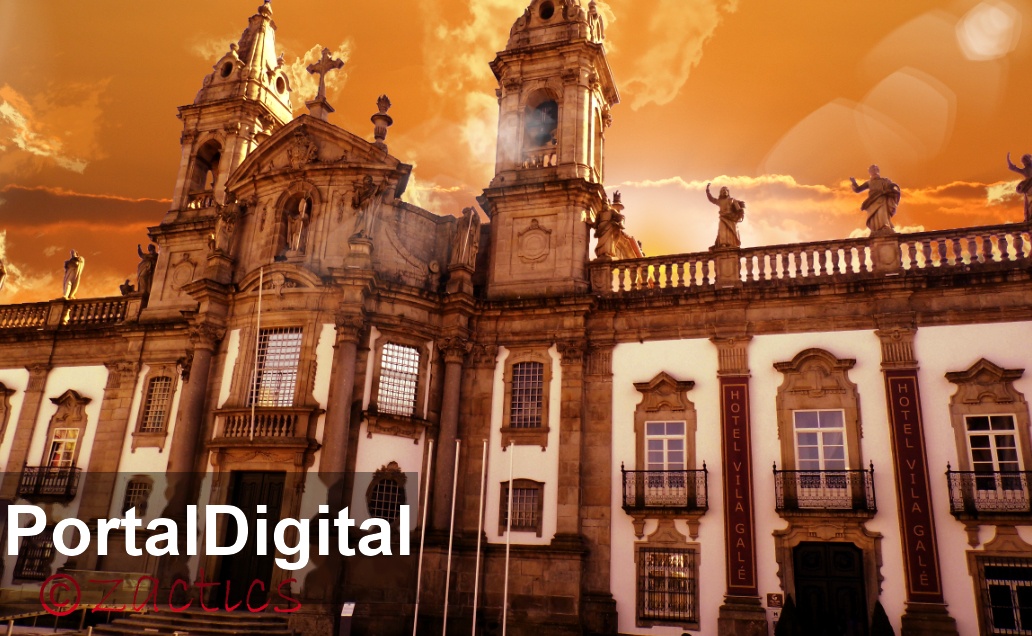
Largo Carlos Amarante, in Braga
The Hospital Church or Church of São Marcos is located in Largo Carlos Amarante, in the city of Braga, northern Portugal.
Construction
The building of the Hospital and the Church of São Marcos dates back to the 18th century and was built according to a project by Carlos Amarante, the architect after whom the square where they are located is named.
The lateral bodies were designed and built by José Fernandes Graça, surnamed Landim and who was in charge of the stonework and sculpture designed by Carlos Amarante.
The lateral bodies were designed and built by José Fernandes Graça, surnamed Landim and who was in charge of the stonework and sculpture designed by Carlos Amarante.
Facade
In Baroque style, the verticality of the Church, with its two towers, contrasts with the horizontality of the hospital facilities that develop symmetrically, creating a harmonious whole.
Its exterior decoration highlights the life-size statues of the apostles that set the rhythm of the upper balustrade. In the middle of the Church's facade, in a niche, we can see the image of Saint Mark.
The hospital was intended to assist the poor, pilgrims and travelers who spent the night in the city of Braga.
On the facade of the church is the statue of Saint Mark, patron of this church and who was bishop of the Eastern Christian Church, at the time of Emperor Constantine.
The relics of the body of the Apostle and Bishop Saint Mark are found in this church for the veneration of the faithful.
The church has the particularity of venerating the Apostle Saint Mark and the Bishop Saint Mark.
The presence in Braga of many Eastern European Orthodox believers had the virtue of drawing attention to this Apostolic "find".
Its exterior decoration highlights the life-size statues of the apostles that set the rhythm of the upper balustrade. In the middle of the Church's facade, in a niche, we can see the image of Saint Mark.
The hospital was intended to assist the poor, pilgrims and travelers who spent the night in the city of Braga.
On the facade of the church is the statue of Saint Mark, patron of this church and who was bishop of the Eastern Christian Church, at the time of Emperor Constantine.
The relics of the body of the Apostle and Bishop Saint Mark are found in this church for the veneration of the faithful.
The church has the particularity of venerating the Apostle Saint Mark and the Bishop Saint Mark.
The presence in Braga of many Eastern European Orthodox believers had the virtue of drawing attention to this Apostolic "find".
Statues
The statues represent Saint Simon, Saint Bartholomew, Saint James the Minor, Saint John the Evangelist, Saint Andrew, Saint Peter, Saint Paul, Saint James the Greater, Saint Thomas, Saint Philip, Saint Matthias and Saint Luke.
On the facade of the church is the statue of Saint Mark, patron of this church and who was bishop of the Eastern Christian Church, at the time of Emperor Constantine.
On the facade of the church is the statue of Saint Mark, patron of this church and who was bishop of the Eastern Christian Church, at the time of Emperor Constantine.
Tomb of Saint Mark
The relics of the body of the Apostle and Bishop Saint Mark are found in this church for the veneration of the faithful.
The church has the particularity of venerating the Apostle Saint Mark and the Bishop Saint Mark. Everything leads us to believe that it is the body of the same Holy Apostle, who was supposed to have disappeared for centuries.
The church has the particularity of venerating the Apostle Saint Mark and the Bishop Saint Mark. Everything leads us to believe that it is the body of the same Holy Apostle, who was supposed to have disappeared for centuries.
Chapel of S. Bentinho
Against the west facade of the building, there is the chapel of S. Bentinho.
This small chapel is baroque and neoclassical from the mid-18th century, and in that year the porch was also built and the main altarpiece was placed.
Inside there was a panel representing Saint Benedict, Our Lady of Light and Saint Bernard and an altar in the shape of a URN.
The chapel of S. Bentinho do Hospital is the perennial trace of the deep-rooted Faith of a people.
Every day, believers pray to S. Bento, light their candles, offer carnations and give alms.
This small chapel is baroque and neoclassical from the mid-18th century, and in that year the porch was also built and the main altarpiece was placed.
Inside there was a panel representing Saint Benedict, Our Lady of Light and Saint Bernard and an altar in the shape of a URN.
The chapel of S. Bentinho do Hospital is the perennial trace of the deep-rooted Faith of a people.
Every day, believers pray to S. Bento, light their candles, offer carnations and give alms.
Hotel
In 2016, the north pavilion, excluding the Church of S. Marcos, the Chapel of S. Bento and the Farmácia da Misericórdia, was transformed into a ‘Vila Galé’ hotel.