
Braga's historic city center
Jardim de Santa Bárbara is located in the parish of Sé, in the historic center of the city of Braga.
It is a municipal public garden, next to the medieval wing of the Paço Episcopal Braga.
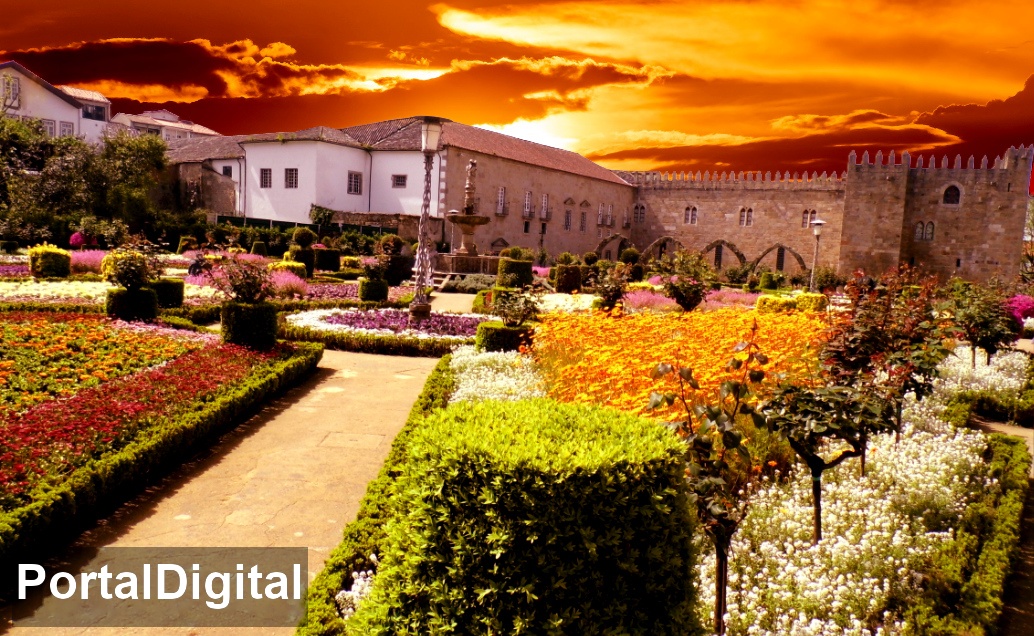
In its center there is a 17th century fountain, which originally belonged to the old Convento dos Remédios, topped by a statue of Santa Bárbara, which gives the garden its name.
The official name as Jardim de Santa Bárbara was approved at the Chamber meeting on February 17, 1955.
On July 9, 2018, the garden was classified as a Cultural Asset of Municipal Interest at an executive meeting of the Braga Chamber
It is a kind of city refuge that invites us to enjoy the flowers in the garden, listen to the birds, take photographs and nearby can have a meal or a snack with friends.
At the end of the garden, a high stone wall trimmed by battlements resembles a castle where the facade is part of the medieval palace of Braga, and was built at the end of the Middle Ages on the initiative of the archbishops D. Gonçalo de Pereira and D. Fernando da Guerra.
It currently functions as the Braga District Archive and is part of a larger complex called Paço Episcopal de Braga.
It is a municipal public garden, next to the medieval wing of the Paço Episcopal Braga.
In its center there is a 17th century fountain, which originally belonged to the old Convento dos Remédios, topped by a statue of Santa Bárbara, which gives the garden its name.
The official name as Jardim de Santa Bárbara was approved at the Chamber meeting on February 17, 1955.
On July 9, 2018, the garden was classified as a Cultural Asset of Municipal Interest at an executive meeting of the Braga Chamber
It is a kind of city refuge that invites us to enjoy the flowers in the garden, listen to the birds, take photographs and nearby can have a meal or a snack with friends.
At the end of the garden, a high stone wall trimmed by battlements resembles a castle where the facade is part of the medieval palace of Braga, and was built at the end of the Middle Ages on the initiative of the archbishops D. Gonçalo de Pereira and D. Fernando da Guerra.
It currently functions as the Braga District Archive and is part of a larger complex called Paço Episcopal de Braga.